
TO: Governor Greg Abbott of Texas
FROM: A Concerned Citizen
DATE: December 6, 2024
RE: Voting Policy in the State of Texas
“Truth is so precious that she should always be attended by a bodyguard of lies”
Winston Churchill
INTRODUCTION
Having recently returned from a summit on voter security in the Peoples’ Republic of Cambridge I am issuing this memo to recap the high points. Although the course has effectively communicated to me many of the merits of our voting system and has set limits and bounds to the amount of votes X which can be produced by a conspiracy of Y participants it has not assured me of the fundamental security of our elections in the face of nefarious actors foreign and domestic. One guest, Lindeman, I believe, mentioned on inspecting vote procedures he left with more questions than answers. If nothing else, I can say that I left the summit with more reassuring answers than worrisome questions. But the worries remain.
ANALYSIS AND DISCUSSION
Foreign Interference
In our summit, we discussed many important vulnerabilities to the election system which could be exploited by foreign actors. I recommend we audit and harden any election critical databases and protect critical data-in-transit by defaulting to transporting data physically on hard drives by hand when possible as opposed to large regular data transfer over the open internet. Keep in mind that data destruction is as great or greater a threat to our public’s faith in elections as is data manipulation.
Vote Security Best Practices versus Enforceable Standards
One guest presented to the attendees a slideshow on election security best practices. These included physical security around ballots as well as a preference for representatives of each party to be present during transportation of ballots. I asked Wyman whether these are enforceable standards or best practices. She said they are NOT enforceable. I was troubled by her response for two reasons. 1.I have no faith that these best practices are enforced faithfully in American inner cities which are often indistinguishable from third world countries in competence of governance or in corruption. 2. More troubling was her attempt to portray these best practices as nationwide standards. If I had not asked her she never would have admitted as such. She went as far to claim, as many have, that 2020 was the most secure election in history with no basis to confirm that that was the case. The lady doth protest too much methinks!
Regarding Voter ID
We had a lengthy discussion on the merits and detriments of voter ID laws. The leader of the discussion directed the discussion in such a way that the issue became one of perceived social justice rather than election security which, of course, was the purpose of the summit.
A non-negligible number of people may be disenfranchised. However, we should not concede to the absurd claim that 15% of the population is disenfranchised. The picture below shows the wide range of options a voter can use to prove identity. It is true that, in order to receive some of these documents, one must possess the faculties to schedule an appointment at any number of government offices, attend the appointment and bring minimal required paperwork. Unfortunately many are incapable of doing these basic tasks and must, therefore, use the backup options on the right of the graphic. Some people will be incapable of performing these tasks as well and they may be disenfranchised. I have found no reliable study which reflects the number of Texans who do not possess any of the below documents but there are likely not very many.
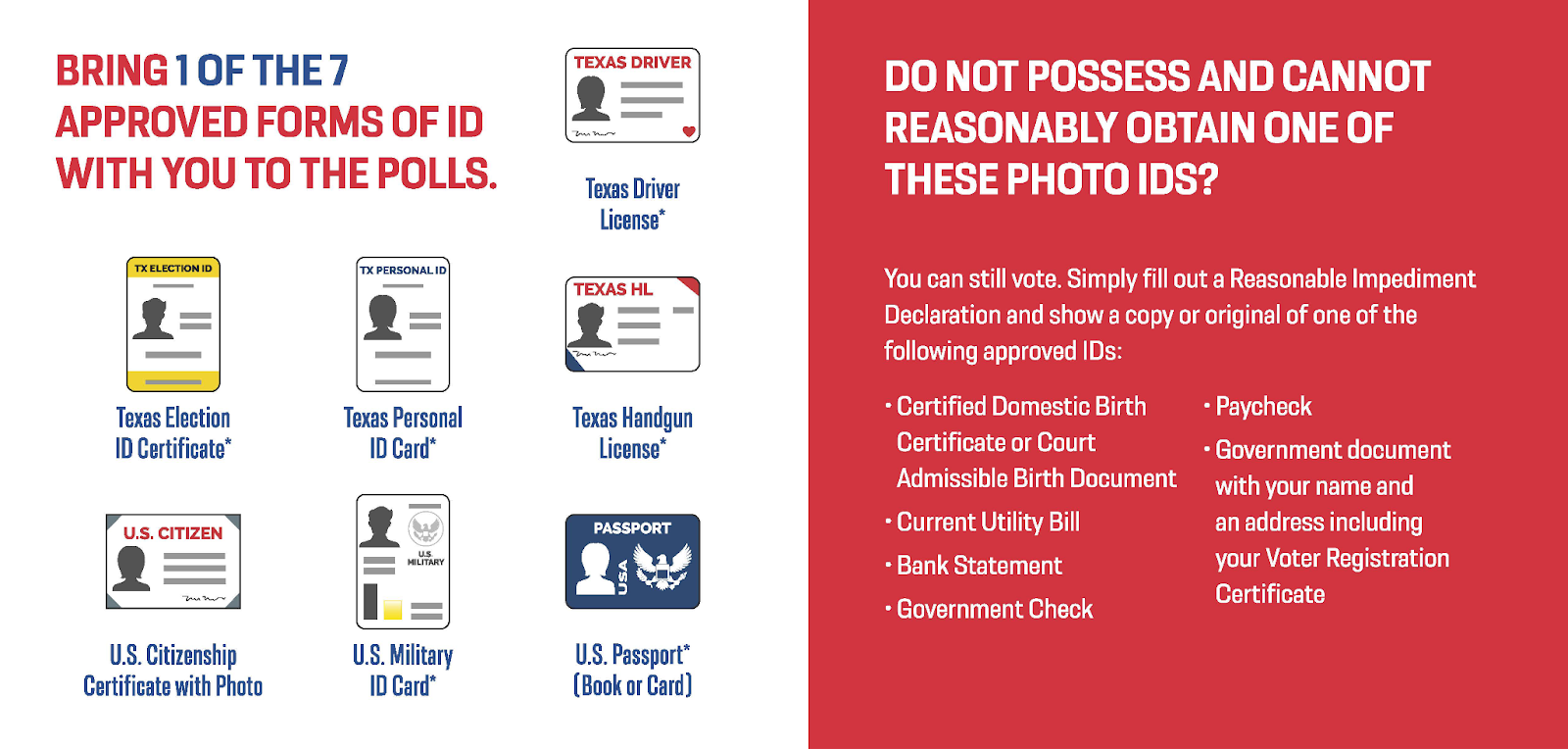
To elaborate, it is misleading to portray the percent of the population not in possession of a driver’s license as a proxy for voter disenfranchisement. Instead the disenfranchised are the people who would otherwise vote and are eligible to vote but cannot because they do not have any ID or any other identification. Those who are so off the grid that they do not possess any of the above likely have little interest in voting either. This is not to say their opinion is irrelevant but to say the population is smaller than one may initially assume. To further understand this population of people we can look at voter turnout in ID v non-ID states. I’ll leave this as an exercise to the reader (Governor) but I can assure you many ID states have higher turnout than many non-ID states and vice versa. There is no obvious causal link.
We may also look at turnout before / after voter ID laws are relaxed as well as compare similar population pools between similar states. These comparisons were made in a recent National Bureau of Economic Research study. The study found that “the laws have no negative effect on registration or turnout, overall or for any group defined by race, gender, age, or party affiliation”.
California and Massachusetts could offer free IDs to their citizens but they choose not to. Why?
Generously, they know even if they provide the ID for free, the same apathetic people will still need to schedule an appointment at the DMV, gather the minimal required paperwork, then take an hour out of their life to go. There still may be voters “disenfranchised” and anti-ID activists would be forced to acknowledge that some people choose not to vote out of an unwillingness to participate in the democratic process rather than a falsely constructed perception of racism.
Cynically, their goal is not representation. Their interest is in undercutting election security
Good governance isn’t scalar relative to election turnout percentage. Even if there was a strong causal link between ID law and turnout, 67% turnout isn’t inherently better than 66%. If the ‘disenfranchised’ were perceived to be Republicans the people of Cambridge would not care about the issue. It’s purely a cynical political game masked as a social justice issue.
Almost all policies / laws / standards will impact different population groups at different rates. The only way to avoid disparate impact is by never enforcing rules. Accepting that laws should exist and standards be upheld, we should debate them on their merits.
This leads to the discussion of security. The purpose of voter ID isn’t to place importance on the ID. It is to place importance on the person. At some point in the entire election process someone should verify that there is a person standing in front of them, that they are who they profess to be and that one person is submitting one ballot. Without the verification of personhood, ballots are just a bunch of paper. Information is infinitely scalable. Paper is O(cn) scalable. Human presence is O(log n) scalable. As a registered voter in Massachusetts (sorry Governor) I registered by mail. This registration required nothing but a mailbox at which to receive a ballot. I then voted by mail - again without an ID, and without proof of personhood. In California, as we discussed in class, tens of millions ballots are sent out by default to all registered voters. Which standard will be relaxed next? The potential for abuse is gigantic and a line must be drawn somewhere.
I doubt Vice President Harris or Senator Warren needed to cheat to win Massachusetts but this is beside the point. Tyrannies happen step by step, then they happen all at once. If all standards for voting security are eroded over time, decried as racist, then eventually someone will come to take advantage of the lack of standards. Maybe they will say something like “anything is justified in defeating their opponent” - a common view held and proclaimed by American elected officials.
Who are those nefarious characters who would rig an election and risk jail time? No one would be so crazy! Well they existed not so long ago in New York, here in Texas, in Chicago and around the world to this day. I posed a question about LBJ’s history of vote rigging not to ask “how did they do it and how has it changed” which are important questions. But to point out that they have done it. Those people existed and they still exist.
Other Considerations and Recommendations
I previously mentioned that I was able to set bounds to the amount of votes X which can be produced by a conspiracy of Y participants. For example, in states with reliably maintained, public facing voter registration and voter records it is highly unlikely that a conspiracy of 10 people could manufacture 100k votes. I further recommend, to reduce the proportion X:Y, we hold elections in-person on one day with initial 99+% ballot counting completed 24 hours following the election. A two month window of ballot submission and ballot counting leads to unacceptably high X:Y. We could require businesses to allow their employees a half-day absence or, federal law permitting, hold the election on a weekend.